
Description
Protocol Overview
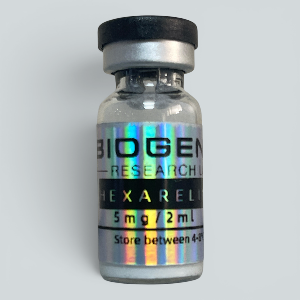
At 2.5 mg/mL a single 5 mg vial holds roughly 2 mL of usable solution — about fifty 100 mcg reference amounts, or fewer if larger per-dose amounts are used.
Because hexarelin desensitizes with continued exposure, the research record describes short courses rather than open-ended use; recalculate your syringe volume whenever the reference amount changes rather than reusing a fixed mark.
Dosing Protocol
Representative reference amounts from the human literature, converted to U-100 units at 2.5 mg/mL. These describe what investigators administered under controlled conditions — not a protocol to follow.
| Reference regimen | Per-dose amount | Volume (U-100 units / mL) |
|---|---|---|
| Low reference (per dose) | 50 mcg | 2 units (0.02 mL) |
| ~Saturating single dose (~1.5 mcg/kg, 70 kg) | 100 mcg | 4 units (0.04 mL) |
| Upper single dose reported | 150 mcg | 6 units (0.06 mL) |
| 1× daily total | 100 mcg | 4 units (0.04 mL) |
| 2× daily (16-week SC study pattern) | ~100 mcg × 2 = 200 mcg | 4 units (0.04 mL) per dose |
| 3× daily total | ~100 mcg × 3 = 300 mcg | 4 units (0.04 mL) per dose |
Storage Instructions
Store the lyophilized vial cold and dark — hexarelin is light- and heat-sensitive — until reconstitution.
After reconstitution, keep the vial refrigerated at 2–8 °C, protected from light, and use within the bacteriostatic-water window (commonly cited as up to ~28 days). Discard if the solution becomes cloudy or discolored.
Important Notes
Practical points that keep measurement consistent and reflect the specific limitations flagged in the literature for this peptide.
- ▪Desensitization is the key caveat: in a 16-week human study, twice-daily subcutaneous hexarelin produced a GH response that fell progressively (area under the GH curve ~19 → ~10.5 µg/L·h), so “more, for longer” does not sustain the effect.
- ▪Not GH-selective: hexarelin also raises ACTH/cortisol and prolactin, more so at higher doses — a documented reason later research favored cleaner secretagogues such as ipamorelin.
- ▪Timing: GH secretagogues are typically studied away from meals, since food and elevated somatostatin can blunt the GH pulse.
- ▪Sterile technique: fresh U-100 syringe each time, straight into a puncture-proof sharps container afterward.
- ▪Prohibited in sport & unapproved: growth hormone secretagogues including GHRPs are banned by the World Anti-Doping Agency, and hexarelin is not an approved drug or dietary supplement anywhere.
How This Works
Hexarelin binds the growth hormone secretagogue receptor type 1a (GHS-R1a) on somatotroph cells of the anterior pituitary — the same receptor later identified as the endogenous target of the hormone ghrelin. Activation triggers a phospholipase-C / inositol-trisphosphate cascade that mobilizes intracellular calcium and releases stored growth hormone. Because this route is distinct from the cAMP pathway used by growth hormone–releasing hormone (GHRH), the two act synergistically: combined, they produce a larger GH pulse than either agent alone, a synergy repeatedly demonstrated in human studies.
Hexarelin is among the most potent peptidyl secretagogues of its era — an intravenous 1 mcg/kg dose released roughly twice the GH of an equivalent GHRH dose. It is not GH-selective, however: it concurrently stimulates ACTH, cortisol and prolactin, and this off-axis activity grows at higher doses. A separate preclinical line of work links hexarelin to the scavenger receptor CD36 in cardiac and vascular tissue, through which it showed GH-independent cardioprotective effects in animal models — findings that remain preclinical and have not become an approved therapy.


